06 - PE Hooking (Deprecated)
Warning
This tutorial is no longer functional as the PE hooking functions have been removed from LIEF.
The objective of this tutorial is to show how to hook imported functions.
The targeted binary is a simple PE64 HelloWorld that prints the first argument to the console:
#include "stdafx.h"
#include <stdio.h>

int main(int argc, char** argv) {
  printf("Hello: %s\n", argv[1]);
  return 0;
}
$ PE64_x86-64_binary_HelloWorld.exe World
$ Hello: World
Using LIEF, we will replace the function that prints the message to the console with a MessageBox.
By disassembling the binary, we can see that the print occurs in the function sub_140001030, which uses two external functions: __acrt_iob_func and __stdio_common_vfprintf.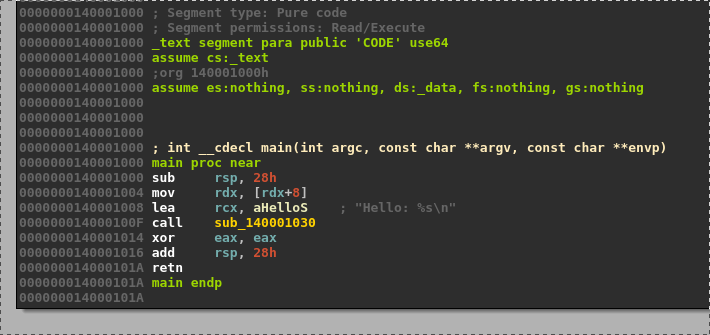
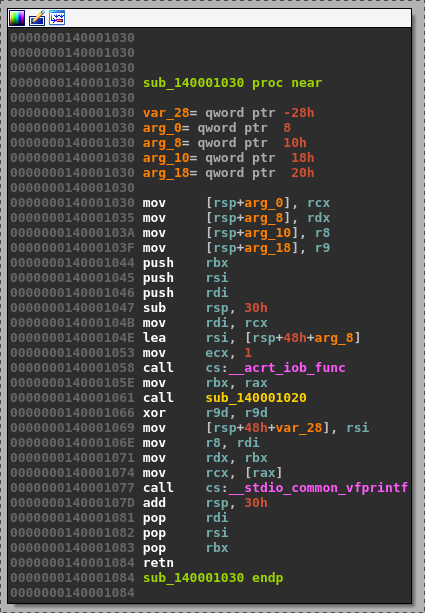
According to the Microsoft x64 calling convention, the format string is located in the rcx register, and the input message is in the rdx register.
Basically, the hooking code replaces the __acrt_iob_func function and displays a MessageBox with the rdx message.
add rsp, 0x48         ; Stack unwind
xor rcx, rcx          ; hWnd
mov rdx, rdx          ; Message
mov r8,  0x0140009000 ; Title
xor r9, r9            ; MB_OK
mov rax, 0x014000A3E4 ; MessageBoxA address
call [rax]            ; MessageBoxA(hWnd, Message, Title, MB_OK)
xor rcx, rcx          ; exit value
mov rax, 0x014000A3d4 ; ExitProcess address
call [rax]            ; ExitProcess(0)
ret                   ; Never reached
Note
As in tutorial 02 - Create a PE from scratch (Deprecated), the addresses of MessageBoxA and ExitProcess can be found using the function:
First, we create the .htext section, which will hold the hooking code:
section_text                 = lief.PE.Section(".htext")
section_text.content         = code
section_text.virtual_address = 0x7000
section_text.characteristics = lief.PE.Section.CHARACTERISTICS.CNT_CODE | lief.PE.Section.CHARACTERISTICS.MEM_READ | lief.PE.Section.CHARACTERISTICS.MEM_EXECUTE

section_text = pe.add_section(section_text)
Next, we create the .hdata section for the MessageBox title:
title   = "LIEF is awesome\0"
data =  list(map(ord, title))

section_data                 = lief.PE.Section(".hdata")
section_data.content         = data
section_data.virtual_address = 0x8000
section_data.characteristics = lief.PE.Section.CHARACTERISTICS.CNT_INITIALIZED_DATA | lief.PE.Section.CHARACTERISTICS.MEM_READ

section_data = pe.add_section(section_data)
Since ASLR is enabled, we will disable it to avoid dealing with relocations:
binary: lief.PE.Binary

binary.optional_header.dll_characteristics &= (
    ~lief.PE.OptionalHeader.DLL_CHARACTERISTICS.DYNAMIC_BASE
)
We will also disable NX protection:
binary: lief.PE.Binary

binary.optional_header.dll_characteristics &= (
    ~lief.PE.OptionalHeader.DLL_CHARACTERISTICS.NX_COMPAT
)
As ExitProcess is not imported in KERNEL32.dll, we need to add it:
binary: lief.PE.Binary

kernel32 = binary.get_import("KERNEL32.dll")
kernel32.add_entry("ExitProcess")
The MessageBoxA function is located in user32.dll, so we must add it:
user32 = binary.add_library("user32.dll")
user32.add_entry("MessageBoxA")
Then, we proceed to hook the __acrt_iob_func function:
pe.hook_function("__acrt_iob_func", binary.optional_header.imagebase + section_text.virtual_address)
Finally, we configure the Builder to create a new import table and patch the original one with trampolines.
builder = lief.PE.Builder(binary)

builder.build_imports(True).patch_imports(True)

builder.build()

builder.write("lief_pe_hooking.exe")
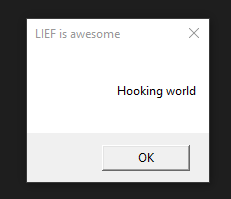
Now we can run the final executable:
$ lief_pe_hooking.exe "Hooking World"