

Python
Parser
- lief.parse(obj: str | io.IOBase | os.PathLike | bytes | list[int]) PE.Binary | OAT.Binary | ELF.Binary | MachO.Binary | COFF.Binary | None
Parse a binary supported by LIEF (ELF, PE, Mach-O, …) from the given Python object and return the corresponding
Binaryobject.
Binary
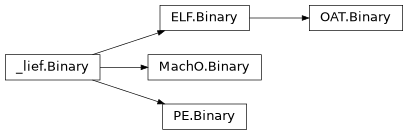
- class lief.Binary
Bases:
ObjectGeneric interface representing a binary executable.
This class provides a unified interface across multiple binary formats such as ELF, PE, Mach-O, and others. It enables users to access binary components like headers, sections, symbols, relocations, and functions in a format-agnostic way.
Subclasses (like
lief.PE.Binary) implement format-specific API- class VA_TYPES(*values)
Bases:
EnumEnumeration of virtual address types used for patching and memory access.
- AUTO = 0
- RVA = 1
- VA = 2
- property abstract lief.Binary
Return the abstract representation of the current binary (
lief.Binary)
- assemble(self, address: int, assembly: str, config: lief._lief.assembly.AssemblerConfig = <lief._lief.assembly.AssemblerConfig object at 0x7f9426654d20>) bytes
Assemble and patch the provided assembly code at the specified address.
The function returns the generated assembly bytes.
Example:
bin.assemble(0x12000440, """
xor rax, rbx;
mov rcx, rax;
""")
If you need to configure the assembly engine or to define addresses for symbols, you can provide your own
AssemblerConfiginstance.
- property concrete lief.ELF.Binary | lief.PE.Binary | lief.MachO.Binary
The concrete representation of the binary. Basically, this property casts a
lief.Binaryinto alief.PE.Binary,lief.ELF.Binaryorlief.MachO.Binary.See also:
lief.Binary.abstract
- property ctor_functions list[lief.Function]
Constructor functions that are called prior to any other functions
- property debug_info lief.DebugInfo | None
Return debug info if present. It can be either a
lief.dwarf.DebugInfoor alief.pdb.DebugInfoFor ELF and Mach-O binaries, it returns the given DebugInfo object only if the binary embeds the DWARF debug info in the binary itself.
For PE file, this function tries to find the external PDB using the
lief.PE.CodeViewPDB.filenameoutput (if present). One can also uselief.pdb.load()to manually load a PDB.Warning
This function requires LIEF’s extended version otherwise it always returns
None
- disassemble(self, address: int) Iterator[lief._lief.assembly.Instruction | None]
- disassemble(self, address: int, size: int) Iterator[lief._lief.assembly.Instruction | None]
- disassemble(self, function_name: str) Iterator[lief._lief.assembly.Instruction | None]
- disassemble(self, address: int, size: int) Iterator[lief._lief.assembly.Instruction | None]
Overloaded function.
disassemble(self, address: int) -> Iterator[Optional[lief._lief.assembly.Instruction]]Disassemble code starting at the given virtual address.
insts = binary.disassemble(0xacde, 100);
for inst in insts:
    print(inst)
See also
disassemble(self, address: int, size: int) -> Iterator[Optional[lief._lief.assembly.Instruction]]Disassemble code starting at the given virtual address and with the given size.
insts = binary.disassemble(0xacde, 100);
for inst in insts:
    print(inst)
See also
disassemble(self, function_name: str) -> Iterator[Optional[lief._lief.assembly.Instruction]]Disassemble code for the given symbol name
insts = binary.disassemble("__libc_start_main");
for inst in insts:
    print(inst)
See also
- disassemble_from_bytes(self, buffer: bytes, address: int = 0) Iterator[lief._lief.assembly.Instruction | None]
Disassemble code from the provided bytes
raw = bytes(binary.get_section(".text").content)
insts = binary.disassemble_from_bytes(raw);
for inst in insts:
    print(inst)
See also
- property entrypoint int
Binary’s entrypoint
- property exported_functions list[lief.Function]
Return the binary’s exported
Function
- property format lief.Binary.FORMATS
File format (
FORMATS) of the underlying binary.
- get_content_from_virtual_address(self, virtual_address: int, size: int, va_type: lief._lief.Binary.VA_TYPES = VA_TYPES.AUTO) memoryview
Return the content located at the provided virtual address. The virtual address is specified in the first argument and size to read (in bytes) in the second.
If the underlying binary is a PE, one can specify if the virtual address is a
RVAor aVA. By default, it is set toAUTO.
- get_function_address(self, function_name: str) int | lief._lief.lief_errors
Return the address of the given function name
- get_int_from_virtual_address(self, address: int, interger_size: int, type: lief._lief.Binary.VA_TYPES = VA_TYPES.AUTO) int | None
Get an integer representation of the data at the given address
- get_symbol(self, symbol_name: str) lief._lief.Symbol | None
Return the
Symbolfrom the givenname.If the symbol can’t be found, it returns None.
- property has_nx bool
Check if the binary has
NXprotection (non executable stack)
- property header lief.Header
Binary’s abstract header (
Header)
- property imagebase int
Default image base (i.e. if the ASLR is not enabled)
- property imported_functions list[lief.Function]
Return the binary’s imported
Function(name)
- property is_pie bool
Check if the binary is position independent
- property libraries list[str | bytes]
Return binary’s imported libraries (name)
- load_debug_info(self, path: str | os.PathLike) lief._lief.DebugInfo | None
Load and associate an external debug file (e.g., DWARF or PDB) with this binary.
This method attempts to load the debug information from the file located at the given path, and binds it to the current binary instance. If successful, it returns the loaded
DebugInfoobject.Warning
It is the caller’s responsibility to ensure that the debug file is compatible with the binary. Incorrect associations may lead to inconsistent or invalid results.
Note
This function does not verify that the debug file matches the binary’s unique identifier (e.g., build ID, GUID).
- offset_to_virtual_address(self, offset: int, slide: int = 0) int | lief._lief.lief_errors
Convert an offset into a virtual address.
- property original_size int
Original size of the binary
- property page_size int
Get the default memory page size according to the architecture and the format of the current binary
- patch_address(self, address: int, patch_value: collections.abc.Sequence[int], va_type: lief._lief.Binary.VA_TYPES = VA_TYPES.AUTO) None
- patch_address(self, address: int, patch_value: int, size: int = 8, va_type: lief._lief.Binary.VA_TYPES = VA_TYPES.AUTO) None
Overloaded function.
patch_address(self, address: int, patch_value: collections.abc.Sequence[int], va_type: lief._lief.Binary.VA_TYPES = VA_TYPES.AUTO) -> Nonepatch_address(self, address: int, patch_value: int, size: int = 8, va_type: lief._lief.Binary.VA_TYPES = VA_TYPES.AUTO) -> None
- property relocations lief.Binary.it_relocations
Return an iterator over abstract
Relocation
- remove_section(self, name: str, clear: bool = False) None
Remove the section with the given name
- property sections lief.Binary.it_sections
Return an iterator over the binary’s abstract sections (
Section)
- property virtual_size int
- xref(self, virtual_address: int) list[int]
Return all virtual addresses that use the
addressgiven in parameter
Header
- class lief.Header
Bases:
ObjectClass which represents an abstracted Header
- class ARCHITECTURES(*values)
Bases:
Enum- ARM = 1
- ARM64 = 2
- LOONGARCH = 11
- MIPS = 3
- PPC = 6
- PPC64 = 12
- RISCV = 10
- SPARC = 7
- SYSZ = 8
- UNKNOWN = 0
- X86 = 4
- X86_64 = 5
- XCORE = 9
- from_value(arg: int) lief.Header.ARCHITECTURES = <nanobind.nb_func object>
- class ENDIANNESS(*values)
Bases:
Enum- BIG = 1
- LITTLE = 2
- UNKNOWN = 0
- from_value(arg: int) lief.Header.ENDIANNESS = <nanobind.nb_func object>
- class MODES(*values)
Bases:
Enum- ARM64E = 16
- BITS_16 = 1
- BITS_32 = 2
- BITS_64 = 4
- NONE = 0
- THUMB = 8
- from_value(arg: int) lief.Header.MODES = <nanobind.nb_func object>
- class OBJECT_TYPES(*values)
Bases:
Enum- EXECUTABLE = 1
- LIBRARY = 2
- OBJECT = 3
- UNKNOWN = 0
- from_value(arg: int) lief.Header.OBJECT_TYPES = <nanobind.nb_func object>
- property architecture lief.Header.ARCHITECTURES
Target architecture
- property endianness lief.Header.ENDIANNESS
Binary endianness
- property entrypoint int
Binary entrypoint
- property is_32 bool
Trueif the binary targets a32-bitsarchitecture
- property is_64 bool
Trueif the binary targets a64-bitsarchitecture
- property modes lief.Header.MODES
Architecture details
- property modes_list list[lief.Header.MODES]
Modes as a list
- property object_type lief.Header.OBJECT_TYPES
Type of the binary (executable, library…)
Section
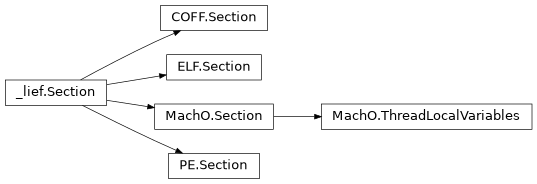
- class lief.Section
Bases:
ObjectClass which represents an abstracted section
- property content memoryview
Section’s content
- property entropy float
Section’s entropy
- property fullname bytes
Return the fullname of the section including the trailing bytes
- property name str | bytes
Section’s name
- property offset int
Section’s file offset
- search(self, number: int, pos: int = 0, size: int = 0) int | None
- search(self, str: str, pos: int = 0) int | None
- search(self, bytes: bytes, pos: int = 0) int | None
- search(self, str: str, pos: int = 0) int | None
Overloaded function.
search(self, number: int, pos: int = 0, size: int = 0) -> Optional[int]
Look for integer within the current section
search(self, str: str, pos: int = 0) -> Optional[int]
Look for string within the current section
search(self, bytes: bytes, pos: int = 0) -> Optional[int]
Look for the given bytes within the current section
- search_all(self, number: int, size: int = 0) list[int]
- search_all(self, str: str) list[int]
Overloaded function.
search_all(self, number: int, size: int = 0) -> list[int]
Look for all integers within the current section
search_all(self, str: str) -> list[int]
Look for all strings within the current section
- property size int
Section’s size
- property virtual_address int
Section’s virtual address
Symbol
Relocation
Function
- class lief.Function(self)
- class lief.Function(self, arg: str, /)
- class lief.Function(self, arg: int, /)
- class lief.Function(self, arg0: str, arg1: int, /)
- class lief.Function(self, arg: str, /)
Bases:
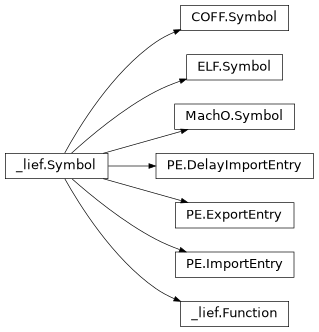
SymbolClass which represents a Function in an executable file format.
- class FLAGS(*values)
Bases:
Flag- CONSTRUCTOR = 1
- DEBUG_INFO = 4
- DESTRUCTOR = 2
- EXPORTED = 8
- IMPORTED = 16
- NONE = 0
- from_value(arg: int) lief.Function.FLAGS = <nanobind.nb_func object>
- add(self, flag: lief._lief.Function.FLAGS) lief._lief.Function
Add the given
FLAGS
- property address int
Function’s address
- property flags lief.Function.FLAGS
Function flags
- property flags_list list[lief.Function.FLAGS]
Function flags as a list of
FLAGS
- has(self, flag: lief._lief.Function.FLAGS) bool
Check if the function has the given flag